
Labor and Exchange in the City
The ProphetThis flow follows the book’s attention to work and the marketplace, where private effort becomes a question of care, fairness, and shared need.
increasing Bearing strength in each event
 decreasing
Bearing strength in each eventdecreasingThe Ploughman’s Question
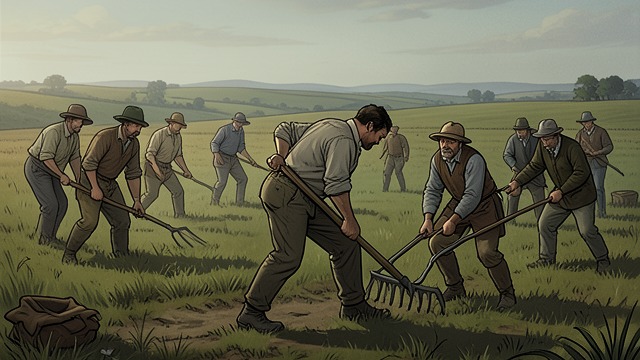
The Ploughman’s Question
Work Named as a Concern
A ploughman asks Almustafa to speak about work. His question brings the field and the labor of ordinary life into a gathering that might otherwise center on abstract ideas.
Labor within Life
Almustafa answers that work keeps people in pace with the earth and its seasons. Work is presented as participation in a larger process rather than merely a burden imposed on individuals.
Work Receives a Spiritual Measure

Work Receives a Spiritual Measure
Labor and Knowledge
Almustafa describes life as darkness without urge, urge as blind without knowledge, knowledge as vain without work, and work as empty without love. The sequence gives labor a moral and emotional measure.
The Worker’s Connection
Working with love binds a person to self, neighbor, and God. The teaching shifts the question from whether work is prestigious to how the worker invests it with attention and care.
The Marketplace Assembles Workers
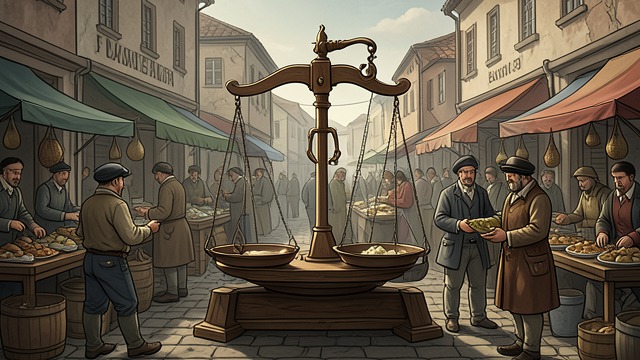
The Marketplace Assembles Workers
Different Trades Meet
Almustafa describes sailors, field workers, vineyard laborers, weavers, potters, and spice gatherers meeting in the market. Their different efforts make exchange a relationship between contributors.
Value under a Common Measure
He asks them to invoke a spirit that sanctifies scales and reckoning. Trade is not just a transfer of goods: its fairness depends on how value and labor are treated.
A Place for Art in Exchange
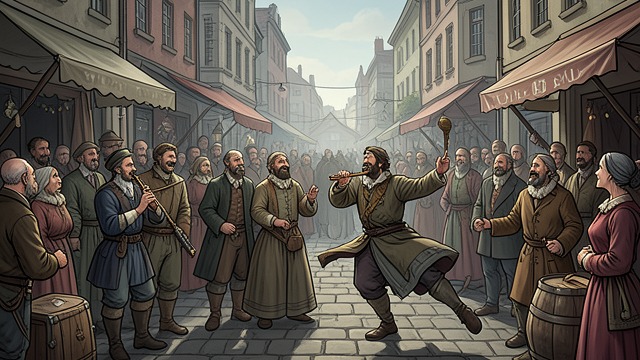
A Place for Art in Exchange
Gifts of Song and Dance
Almustafa includes singers, dancers, and flute players among those whose gifts should be bought. Their work may be fashioned from dreams, yet he says it can nourish the soul.
Beyond Material Use
The marketplace becomes a place where practical goods and imaginative work have a place together. Exchange is richer when the community recognizes needs that cannot be measured only by immediate utility.
No One Leaves Empty-Handed
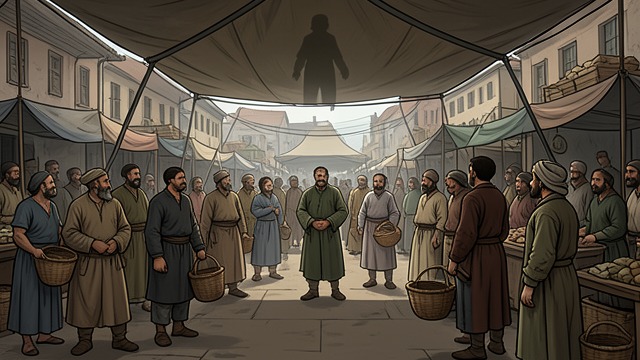
No One Leaves Empty-Handed
A Collective Obligation
Almustafa asks the people to see that no one leaves the marketplace empty-handed. He ties the peace of the earth’s spirit to whether even the least person’s needs are satisfied.
Mutual Aid as the Test
The marketplace’s success is measured not only by exchange but by whether its benefits reach those in need. The teaching closes the thread by making abundance a shared responsibility.
During the farewell teachings, after the food discussion
In the first half of the work teaching
Later in the teachings, when a merchant asks about exchange
Near the end of the buying and selling teaching
At the conclusion of the buying and selling teaching
